Last year, “David” gets on a Zoom with me.
First thing I notice? He looks exhausted. Second thing? He’s terrified.
His coaching business was cruising at $270K/month to start the year. Now it’s flatlined. Ad costs climbing. Close rates tanking. And he’s got a team depending on him.
“If I don’t figure this out soon, I’m gonna have to let people go.”
What was really breaking David’s business?
I ask him to walk me through his business. He shares his screen. And I immediately see the problem.
It looks like a Rube Goldberg machine had a baby with a spreadsheet. Multiple offers. Multiple client avatars. Multiple sales processes. And a spiderweb of automation connecting it all together.
“How long did this take you to build?”
“About 3 months.”
“How long does it take to FIX when something breaks?”
Long pause.
“Hours. Sometimes days. It’s like having a second job, dude.”
There it was. David thought MORE automation would save him. So he kept building. Content automations. Email automations. Ad automations. Complicated triggers and conditions.
And he still had no idea where his best leads came from.
- Every time a lead came in, his team had to manually figure out which funnel they entered through.
- Every time he wanted to test new messaging, he had to update it in 47 different places.
- Every time something broke, it took half a day just to FIND the break.
The automation was creating more work than it saved. Sound familiar?
Why does more automation often create more work?
I see this constantly in 2026. Someone gets excited about AI. They see a YouTube video about automating their business. So they start connecting tools and skills (soooo many random Claude skills). And six weeks later they’re drowning.
Not in leads. In maintenance.
AI was supposed to make this all easier, right? Not when you automate everything!
What is the 3S Test?
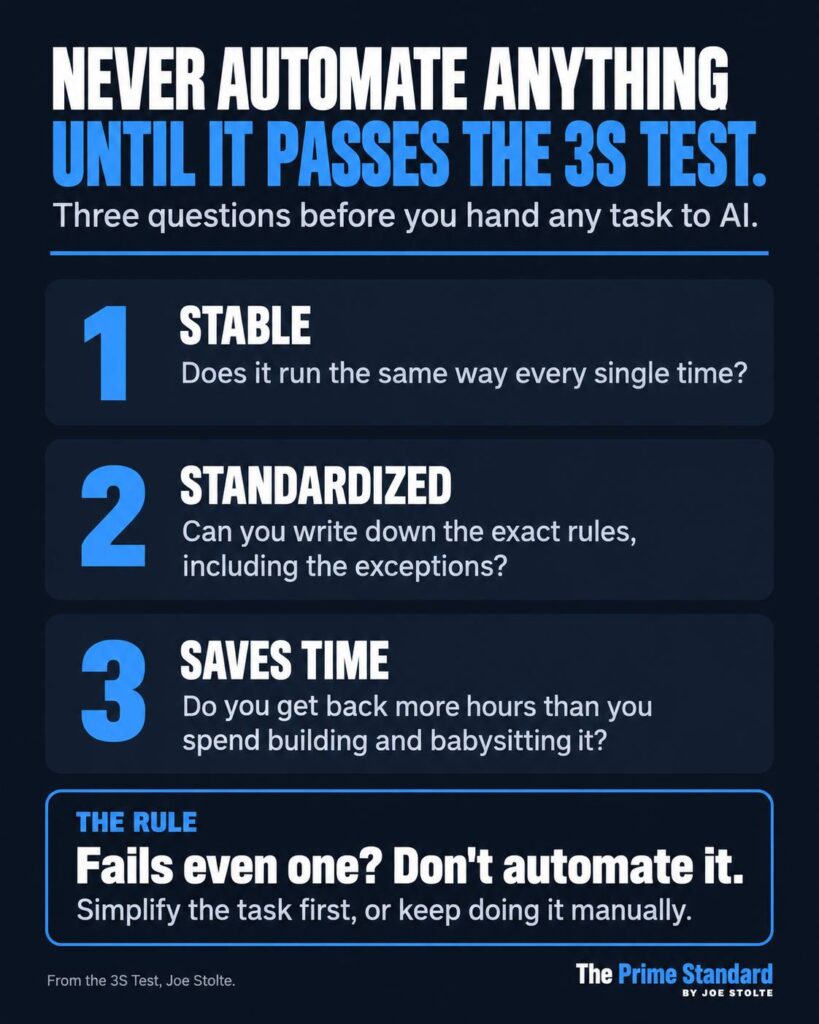
Here’s the rule I gave David (and now I’m giving you): never automate anything until it passes the 3S Test.
Three questions. Before you automate ANYTHING.
1. Is it Stable?
Does this run the same way every single time? Or does it change based on context, judgment, or your mood? If it’s different every time, don’t automate it yet.
2. Is it Standardized?
Can you write down the exact rules for how this works, including what to do when something weird happens? If you can’t document it clearly, you can’t automate it cleanly.
3. Does it Save time?
Will you actually get back MORE hours than you spend building it and babysitting it?
Here’s the trap most people fall into: some automations SOUND like they save time. Then you spend two hours every week making sure the AI didn’t screw something up.
That’s not leverage. That’s a new unpaid job.
Which tasks pass the 3S Test, and which fail?
Let me give you a real example: categorizing receipts with your bookkeeper.
- Stable? Yep. Every receipt gets sorted the same way every month.
- Standardized? Yep. Your bookkeeper already has the categories written down. Meals, travel, software, and the handful that need human review.
- Saves time? Heck yes. Fifteen minutes to set up. Nothing to maintain. At least thirty minutes back every week.
That passes the 3S Test.
Now compare that to using AI for sales calls.
- Not stable. Every conversation is different.
- Not standardized. Every prospect needs different questions, different stories, different judgment calls.
- Doesn’t save time. You’re still prepping. Still reviewing. Still fixing AI mistakes.
That fails the 3S Test.
How did David add $110K a month without automating more?
Back to David. Here’s what we did.
Before touching ANY automation, we simplified. One offer, one ideal client, one sales process. We stripped out everything that wasn’t directly helping clients get results.
Then, and ONLY then, did we start automating.
We used the Find, Filter, Free framework:
We ran it through the Replacement Matrix:
Then we used the 3S Test.
The result? Within 60 days, David added an extra $110K/month. Same team, way less stress, better clients, and a growing business. (Let’s be honest, we love the momentum of growth as much as we love the money.)
Not because he automated MORE. Because he automated SMARTER.
Your homework this week
Make a list of every task you’re thinking about automating. Run each one through the 3S Test: Stable? Standardized? Saves time?
If it fails even ONE of those questions, don’t automate it. Either simplify the task first, or just keep doing it manually.
Because the goal isn’t to automate everything. The goal is to get your TIME back. And bad automation steals more time than it gives.
Onwards, Joe
Want help putting this to work?
- Binge my best training on using AI to grow revenue without hiring more people on YouTube.
- I’ve installed AI in 400+ businesses. This video breaks down why most people get stuck and how to actually save time and drive revenue.
- Want my team to install AI agents in your business that save you at least 15 hours of your time? Learn more.